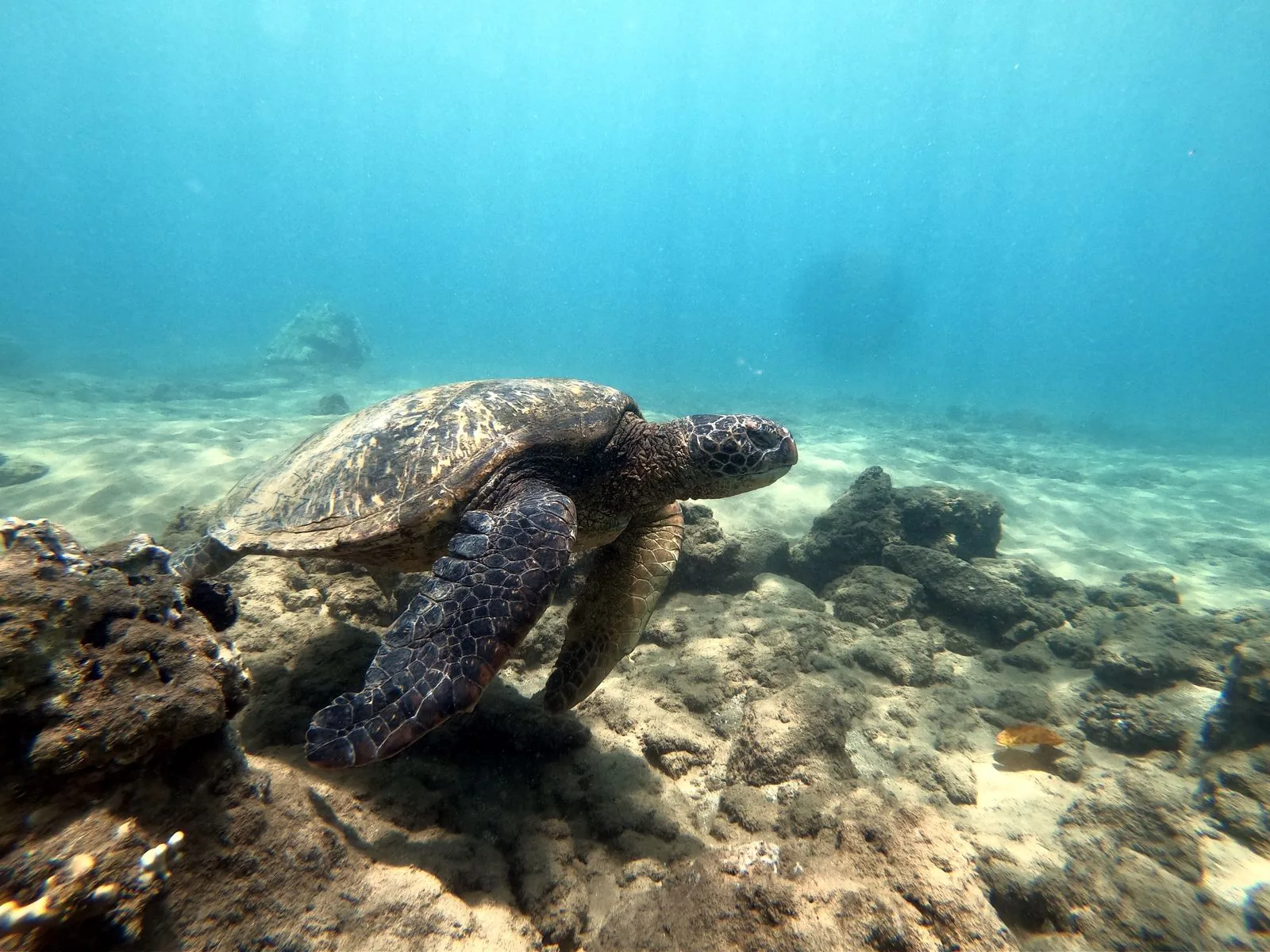
The best places to snorkel in Hawaii depend on the month more than the island. From November to April, stick to south and sheltered west-side spots like Hanauma Bay on Oahu, Kahalu’u Beach Park on the Big Island and Poipu on Kauai. From May to October, the north-shore reefs open up: Shark’s Cove on Oahu, Honolua Bay on Maui and Ke’e Beach on Kauai.
Most lists rank spots by how pretty the fish are. We sorted nine of them by the things that decide whether your snorkel day happens at all: the calm season, whether a lifeguard is on duty, and what you have to book or pay first.
We may earn a commission when you buy through links on this page, at no extra cost to you. As an Amazon Associate we earn from qualifying purchases.
How we chose these spots
We didn’t snorkel these sites for this article. Every spot is either a state Marine Life Conservation District (MLCD), where taking any marine life is banned, or a lifeguarded beach park with a well-known reef.
Seasons and hazards come from the Division of Aquatic Resources (DLNR) pages for each MLCD and from the state’s Hawaii Ocean Safety site. Lifeguard hours come from the state’s list of lifeguarded beaches. Fees and booking rules come from the City and County of Honolulu, Hawaii State Parks and the National Park Service. Everything was checked on November 20, 2026.
Hawaii snorkel spots compared
| Spot | Island, shore | Calm season | Lifeguard | Cost and booking (non-residents) | Protection |
|---|---|---|---|---|---|
| Hanauma Bay | Oahu, southeast | Most of the year | Yes | $25 per person 13+, $3 cash parking; book 2 days ahead | MLCD (1967) |
| Shark’s Cove (Pupukea) | Oahu, north | About May-Oct | No (Waimea Bay nearby has one) | Free | MLCD |
| Molokini Crater | Off south Maui, boat only | Mornings, inside the crescent | Boat crew only | Boat tour price | MLCD (1977) |
| Honolua Bay | Maui, northwest | Summer, calm seas only | No | Free, roadside parking | MLCD |
| Kahalu’u Beach Park | Big Island, west | Most days inside the reef | Daily from 9:30 a.m. | Paid parking ($12 for 4 hours) | County beach park |
| Kealakekua Bay | Big Island, west | Calm days; strong current possible | No | No park fee; hike or permitted kayak tour | MLCD |
| Two Step (Honaunau Bay) | Big Island, west | Calm days | No | Free boat-ramp access | Outside the national park |
| Poipu Beach Park | Kauai, south | Winter | Daily 8 a.m.-6 p.m. | Free | County beach park |
| Ke’e Beach | Kauai, north | About May-Sep | Daily 8 a.m.-6 p.m. | $5 per person + parking or shuttle; book up to 30 days ahead | Haena State Park |
“No” in the lifeguard column means the spot isn’t on the state’s list of lifeguarded beaches. In those places, call 911 in an emergency.
Oahu
1. Hanauma Bay: best first snorkel in Hawaii
Hanauma Bay became the state’s first Marine Life Conservation District in 1967, and the fish have had nearly 60 years without fishing pressure. It sits in an old volcanic crater on Oahu’s southeast tip, and the city runs the land side as a nature preserve.
It’s open Wednesday to Sunday only. Entry runs from 6:45 a.m. to 1:30 p.m., and everyone leaves by 4 p.m. Non-residents 13 and older pay $25 plus a 2.35% online fee; kids 12 and under are free. Parking is $3, cash only, and a reservation doesn’t guarantee a stall.
Admission-only reservations open two days ahead at 7 a.m. Hawaii time, so Monday morning is when you book Wednesday. Since December 2025, packages with round-trip transport from Waikiki and Ala Moana can be booked a month ahead through Roberts Hawaii. About a quarter of entries are kept for walk-ins, and every visit starts with a short safety video.
Skip it if: your only free days are Monday or Tuesday, or you won’t be up early enough to book at 7 a.m.
2. Shark’s Cove: best summer snorkel on the North Shore
Shark’s Cove is part of the Pupukea MLCD, along with Three Tables and Waimea Bay. DLNR says the cove is fairly shallow, up to about 20 feet at its mouth, with caves around the northwest point. Visibility is often poor inside the cove and improves outside it. The name isn’t a warning: the state notes sharks are no more common here than elsewhere on Oahu.
The catch is the calendar. DLNR says the water is generally calm from about May through October, while in winter currents and waves become extremely dangerous across the whole district, tidepools included. There are no lifeguards at Shark’s Cove or Three Tables. The city planned a new lifeguard tower at the tidepools for spring 2026, so check whether it’s staffed when you arrive.
Skip it if: you’re visiting between November and April. Use Hanauma Bay instead.
Maui
3. Molokini Crater: best visibility, boat only
Molokini is a crescent-shaped islet about three miles off Maui’s southwest coast, and the only way to snorkel it is by boat from Lahaina, Maalaea Harbor or Kihei. The 77-acre MLCD was set up in 1977, and the islet itself is a state seabird sanctuary you can’t land on.
Tour boats moor inside the crescent, where the water is most sheltered. DLNR warns that currents can always be a problem outside the cove and may get stronger inside in the afternoon, when the wind picks up. That’s why most tours leave early. The state’s pre-trip briefing asks you to stay near your boat, avoid touching the bottom, and use a flotation device if you need one.
Skip it if: you get seasick or want to snorkel on your own schedule.
4. Honolua Bay: best coral on Maui, summer only
Honolua Bay and neighboring Mokuleia Bay form one MLCD on Maui’s northwest coast. DLNR describes dense coral on both sides of Honolua in 10 to 40 feet of water, especially along the northeastern shoreline, plus small caves near the left point.
Two things spoil it. The stream at the head of the bay can make the water near the boat ramp murky, and the state says the bays should be avoided in winter, when high surf is common. There are no lifeguards and no facilities.
Skip it if: there’s surf, recent heavy rain, or you need a restroom nearby.
Maui County only allows mineral sunscreen (zinc oxide or titanium dioxide) since October 2022, which covers Molokini and Honolua. More on that below.
Big Island (Hawaii Island)
5. Kahalu’u Beach Park: best for turtles with a lifeguard
Kahalu’u, on Alii Drive south of Kailua-Kona, is the Big Island’s easiest lifeguarded snorkel. The state lists lifeguards daily from 9:30 a.m., and The Kohala Center, which runs the on-site ReefTeach volunteers, recommends waiting until then before you get in.
Enter through the channel in front of the lifeguard tower, not over the rocks, which are slippery, sharp and where green sea turtles feed. ReefTeach volunteers are on the sand from 8:30 a.m. to 3 p.m. and place orange buoys where the sand ends and the coral starts; don’t stand or kick past them. The center also warns that large waves, strong currents and sea urchins are common, and the county can close the park for coral spawning, bleaching or extreme low tides.
Non-residents pay for parking; local guides list $12 for four hours as of October 2026.
Skip it if: you want solitude. This is a busy, popular bay.
6. Kealakekua Bay: best reef, hardest to reach
Kealakekua Bay is both an MLCD and a state historical park, best known for the Captain Cook monument at Ka’awaloa Flats. The park has no entrance fee and is open 7 a.m. to 8 p.m.
Getting to the snorkeling near the monument is the hard part. State Parks lists two ways onto Ka’awaloa Flats: hike the historic Ka’awaloa Trail (no restrooms, pack out your trash) or join a guided kayak tour with one of the permitted operators. Every vessel in the bay, including kayaks and paddleboards, needs a State Parks permit, launching from Napoopoo wharf is prohibited, and permitted vessels may not land at Ka’awaloa. If you rent a kayak, confirm with the owner that it has a valid permit. The park lists dangerous shorebreak and strong current as hazards.
Skip it if: you’re not up for a steep hike or a paddle across open water.
7. Two Step (Honaunau Bay): best free shore entry
Two Step is named for the lava ledge snorkelers use to step in. Many guidebooks put it inside Pu’uhonua o Honaunau National Historical Park, but the National Park Service says it isn’t: it’s just outside the park, at the Honaunau Bay boat ramp. Snorkelers are not allowed to enter the water at Keone’ele Cove inside the park, a culturally important site.
It isn’t on the state lifeguard list, so go with a buddy and only on calm days.
Skip it if: you need a sandy entry. You’ll be stepping off lava rock.
Kauai
8. Poipu Beach Park: best winter snorkel on Kauai
Poipu sits on Kauai’s sunny south shore, which is the calm side in winter. Two lifeguard towers, Nukumoi and Poipu, are staffed daily from 8 a.m. to 6 p.m. Entry is free. Hawaiian monk seals often haul out on the sand, and NOAA asks you to stay at least 50 feet away.
Skip it if: you’re going in summer, when south shores can pick up swell. Ke’e is the better summer pick.
9. Ke’e Beach: best summer lagoon, if you can book it
Ke’e is at the end of the road on Kauai’s North Shore, inside Haena State Park. It has a lifeguard daily from 8 a.m. to 6 p.m., but every non-resident needs an advance reservation: $5 per person entry, plus a parking slot or a shuttle seat. Reservations open 30 days ahead and sell out fast. The state page lists parking at $10 per vehicle, while current booking guides quote $20 per car per time slot, so trust the price at checkout.
Like every north shore, it’s a summer spot. Winter swells can make the lagoon unsafe.
Skip it if: you can’t book a month ahead or you’re going between November and April.
Which shore is calm in which month?
Hawaii’s surf runs on a simple seasonal swap, per the state’s ocean safety guidance. In winter (about November to April), north-facing shores get large, dangerous swells, so the south shores are your best bet. In summer (about May to October), it flips: south shores can get big swells while north shores often go flat. West shores can catch north swells that wrap around in either season.
- November to April: Hanauma Bay, Kahalu’u, Poipu, and Molokini on calm mornings.
- May to October: add Shark’s Cove, Honolua Bay and Ke’e Beach.
- Any month, first-timers: pick a spot with a lifeguard (Hanauma, Kahalu’u, Poipu, Ke’e) and ask the guard about the day’s currents before you swim.
Whatever the month, conditions on the day beat any guide. Check the Hawaii Ocean Safety site the morning you go, and if surf is breaking across the entry, switch spots.
Rules to know before you get in
Inside an MLCD, you can’t take or injure any marine life, shells or coral, and you can’t feed fish. Give green sea turtles at least 10 feet of space and monk seals 50 feet (150 feet for a mother with a pup), per NOAA.
Hawaii has banned selling sunscreen with oxybenzone or octinoxate since January 1, 2021. Maui County (Maui, Molokai and Lanai) goes further: since October 1, 2022, only mineral sunscreens with zinc oxide or titanium dioxide are allowed. Packing a mineral one from home covers every island.
Gear worth bringing from home
Renting works fine, but your own mask fits better and is ready when the water is calm. We picked traditional mask-and-snorkel sets with a dry-top snorkel, which has a float valve that closes when a wave washes over. Ratings were checked on Amazon on November 20, 2026.
| Product | What’s in it | Lens | Amazon rating (Nov 2026) |
|---|---|---|---|
| Greatever dry snorkel set | Mask, dry-top snorkel, mesh bag | Tempered glass | 4.4/5 from 9,900+ ratings |
| Aegend snorkel set | Mask (L/XL or S/M), dry-top snorkel, mesh bag | Polycarbonate, 220° view | 4.3/5 from 1,900+ ratings |
| ZEEPORTE mask fin snorkel set | Mask, dry-top snorkel, adjustable fins, bag | Tempered glass | 4.4/5 from 8,700+ ratings |
Greatever Dry Snorkel Set: best all-round mask
A tempered-glass mask with a soft silicone skirt and a dry-top snorkel. Amazon’s review summary says buyers find it comfortable, easy to put on and good value, and that it fits ages 15 and up well.
Who it’s for: most adults who want one simple set for a week of shore snorkeling. Who should skip it: anyone who needs fins included.
- Pro: high rating across nearly 10,000 reviews
- Pro: glass lens, dry-top valve and purge valve
- Con: anti-fog and leak reviews are mixed
- Con: no fins
Aegend Snorkel Set: best for smaller faces
Aegend sells the mask in two sizes: L/XL for most adults and S/M for teens and narrow faces. The lens is polycarbonate, which the maker says is more impact resistant than tempered glass, and the purge valve sits separate from the mouthpiece tube.
Who it’s for: teens and adults whose masks usually leak because they’re too big. Who should skip it: anyone who prefers a glass lens.
- Pro: two mask sizes
- Pro: maker offers a 12-month replacement for fogging, leaking or broken parts
- Con: maker says the anti-fog coating needs a fresh-water rinse before each use and shouldn’t be wiped
- Con: smaller review pool than the other two
ZEEPORTE Mask Fin Snorkel Set: best if you want fins
This set adds open-heel fins with adjustable straps to a tempered-glass mask and dry-top snorkel, all in one zip bag. Fins help at spots with longer swims like Honolua Bay or the reef at Kealakekua.
Who it’s for: confident swimmers heading to bigger bays. Who should skip it: anyone packing carry-on only, since fins take space.
- Pro: complete kit in one bag
- Pro: reviewers find the fins comfortable
- Con: durability reviews are mixed, with some reporting breakage
- Con: some reviewers say the mask fogs
Two extras for Hawaii
Thinksport Mineral Sunscreen SPF 50+ uses zinc oxide, is rated water resistant for 80 minutes, and is free of oxybenzone, so it meets Maui County’s mineral-only rule. The Earth Pak 10L dry bag is a 500D PVC roll-top bag that comes with a waterproof phone case, which helps on a Molokini boat or a Kealakekua kayak tour.
Which Hawaii snorkel spot should you pick?
- First snorkel ever, Oahu: Hanauma Bay, booked two days ahead at 7 a.m.
- Turtles with a lifeguard, Big Island: Kahalu’u, after 9:30 a.m.
- Kids on Kauai in winter: Poipu Beach Park.
- Best water clarity, don’t mind a boat: Molokini on a morning tour.
- Summer trip, strong swimmer: Shark’s Cove or Honolua Bay on a flat day.
- Free and independent on the Big Island: Two Step on a calm morning.
Still choosing an island? Our Maui vs Kauai comparison and best Hawaiian island for kids guide cover the bigger picture, and best beaches in Hawaii covers swimming beaches. Heading to the Caribbean too? See best snorkeling in the Caribbean.
FAQ
Which Hawaiian island has the best snorkeling?
Each island has a strong spot for its calm season. For a winter trip, Oahu (Hanauma Bay) and the Big Island’s Kona coast (Kahalu’u, Two Step) are the most reliable. In summer, Maui’s Honolua Bay and Kauai’s North Shore open up.
Do you need a reservation to snorkel in Hawaii?
Only at a few spots. Of these nine, Hanauma Bay (recommended, opens two days ahead) and Ke’e Beach in Haena State Park (required, opens 30 days ahead) need bookings for non-residents. Molokini needs a boat tour.
Is it safe to snorkel in Hawaii in winter?
On south and sheltered west shores, often yes. North shores like Shark’s Cove and Honolua Bay get large, dangerous surf in winter, and DLNR advises avoiding them then. Pick a lifeguarded beach and check that morning’s conditions.
Can you touch sea turtles while snorkeling?
No. Green sea turtles are protected, and NOAA asks you to stay at least 10 feet away. In an MLCD, you also can’t feed fish or touch coral.
Sources
- Honolulu Department of Parks and Recreation: Hanauma Bay Nature Preserve (hours, fees, reservations, walk-ins)
- DLNR Division of Aquatic Resources: Marine Life Conservation Districts, Pupukea, Molokini Shoal, Honolua-Mokuleia, Molokini pre-trip briefing
- Pupukea lifeguard tower plan: Act 31 Pupukea MLCD final report
- Hawaii State Parks: Kealakekua Bay State Historical Park, Haena State Park
- Ke’e parking price and shuttle: hawaiisnorkelspots.com
- National Park Service: Snorkeling at Pu’uhonua o Honaunau
- The Kohala Center: Kahalu’u Bay; parking fee: lovebigisland.com
- Hawaii Ocean Safety: list of lifeguarded beaches, surf seasons
- Sunscreen: HRS 342D-21, Maui County mineral-only sunscreen
- Wildlife distances: NOAA Fisheries
- Products: Amazon listings ASIN B07GVDY9TQ, B0D8T1X73S, B07Q6R2VFX, B007SNM6OK, B01GZCUCO0 (Creators API features and amazon.com ratings and review summaries).
All sources checked November 20, 2026. Fees and hours change, so confirm before you go.