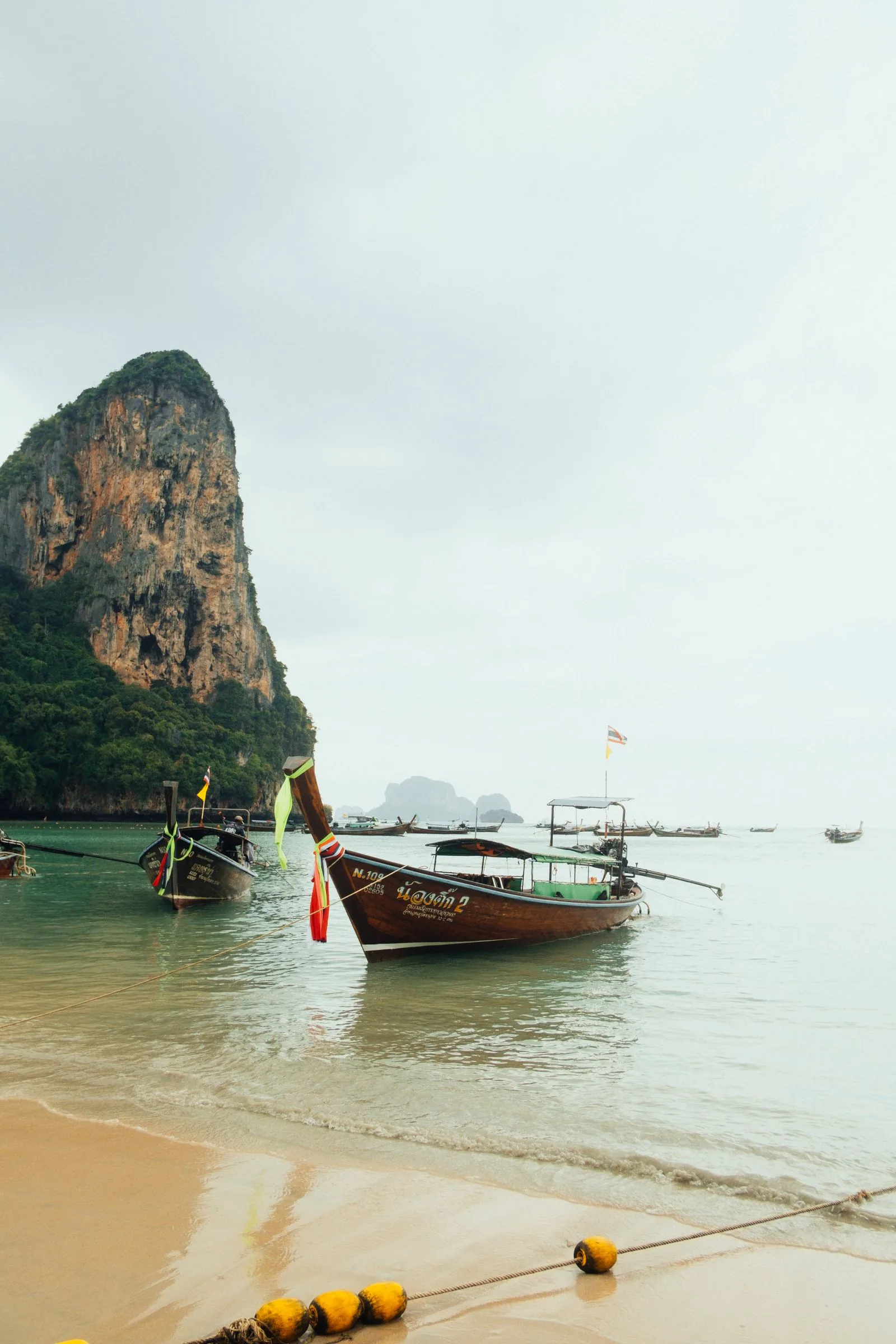
Short answer: the best beaches in Thailand from November to April are on the Andaman coast, with Phra Nang Cave Beach at Railay (Krabi) as our top pick because it combines calm dry-season water, cliff scenery and no road traffic. From May to October, when the Andaman monsoon closes parks and raises red flags, Koh Samet on the eastern Gulf coast is the most practical swap. Season decides more than the beach itself, so this guide sorts seven picks by coast, closure dates, park fees and the swim risks that actually cause harm.
We may earn a commission when you buy through links on this page, at no extra cost to you. As an Amazon Associate we earn from qualifying purchases.
How we chose
We did not visit these beaches for this article. We compared official and recent sources: closure notices from Thailand’s Department of National Parks (DNP) as reported by Bangkok Post and Nation Thailand, the DNP fee schedule, the Thai Meteorological Department’s monsoon calendar, the Land Development Department’s rainfall notes, Phuket Provincial Administrative Organisation drowning figures, and a peer-reviewed study of box jellyfish stings in the Gulf of Thailand. Fees and dates were checked in November 2026. Where sources disagree, we say so.
Two coasts, two monsoons: the rule that picks your beach
Thailand has two beach coasts with opposite wet seasons. The Thai Meteorological Department says the southwest monsoon covers the country from about mid-May to mid-October and brings heavy rain to coasts facing it, which means the Andaman side: Phuket, Krabi, Phi Phi, the Similans and Koh Lipe. The northeast monsoon follows from mid-October to mid-February. It is dry for most of the country, but it pushes moisture from the Gulf onto the southern east coast. Thailand’s Land Development Department notes that rain on the southern west coast peaks in September, while the southern east coast peaks in November and stays wet into January.
So the simple rule is: Andaman beaches from about November to April, Gulf islands like Koh Samui as a mid-year option, and Koh Samet (further north on the eastern Gulf) as the closest year-round fallback to Bangkok.
The 7 beaches compared
| Beach | Coast | Best months | Closure / access rule | Foreign adult park fee | Main swim risk |
|---|---|---|---|---|---|
| Phra Nang Cave Beach, Railay | Andaman (Krabi) | Nov-Apr | Boat only, longtail ~100 baht from Ao Nang | Inside a national park; no separate beach fee reported | Longtail traffic; rough crossings May-Oct |
| Maya Bay, Koh Phi Phi Le | Andaman (Krabi) | Nov-Apr | Closed every year 1 Aug-30 Sep; timed visits | 400 baht | Swimming restricted (see below) |
| Similan Islands | Andaman (Phang Nga) | Dec-Apr | Park open only 15 Oct-15 May | 500 baht | Open-sea crossing, about 1 h 30 by speedboat |
| Nai Harn, Phuket | Andaman (Phuket) | Nov-Apr | Road access | None | Rip currents in the monsoon |
| Sunrise Beach, Koh Lipe | Andaman (Satun) | Dec-Apr | Few boats Jun-mid Oct; park closure dates disputed | 200 baht (Tarutao NP) | Rough seas mid-year |
| Lamai and Chaweng, Koh Samui | Gulf (Surat Thani) | Feb-Sep | Road access | None | Box jellyfish, mostly Jul-Oct |
| Koh Samet, Rayong | Eastern Gulf | Nov-Apr (usable most of the year) | Ferry from Ban Phe, about 6.5 km | 200 baht | Weekend crowds from Bangkok |
Fees and dates checked November 2026. Park fees can change; check the board at the checkpoint.
1. Phra Nang Cave Beach and Railay West, Krabi: best overall
Railay is a peninsula cut off from the road network by limestone cliffs, so every visitor arrives by boat, usually a shared longtail from Ao Nang that takes 10 to 15 minutes. Several 2026 guides report about 100 baht per person one way by day, with a higher fare in the evening. Boats leave when roughly eight passengers have bought tickets at the beachfront booth.
Phra Nang Cave Beach, at the southern tip, has the Princess Cave shrine at one end and is the swimming beach most guides rank first. Railay West is the main beach where Ao Nang boats land. Railay East is mangrove and mudflat, not a swimming beach.
Go if: you want the classic karst-cliff scenery and can stay overnight or start early. Skip if: you need step-free access with heavy luggage; landings at Railay West are wet landings in the shallows.
Trade-offs: day-tour boats crowd Phra Nang between roughly 11:00 and 15:00, so arrive before 10:00 or stay for the late afternoon. From May to October, swell on the Ao Nang side can delay or cancel longtails; guides recommend the Ao Nam Mao crossing to Railay East in the monsoon because it is more sheltered.
2. Maya Bay, Koh Phi Phi Le: best for scenery, with strict rules
Maya Bay sits in Hat Noppharat Thara-Mu Ko Phi Phi National Park and closes every year from 1 August to 30 September for reef recovery and monsoon safety. It reopened on 1 October 2026. Boats no longer enter the bay; they land at Loh Samah pier on the back of the island, and visitors walk in on a boardwalk for a timed visit of about an hour. The foreign adult fee at the Phi Phi islands is 400 baht and the child fee 200 baht, a special rate above the park’s standard category fee. The park sells e-tickets through the QueQ app; tours often include the fee, but some booking platforms exclude it, so read the inclusions.
Sources disagree on swimming. Most park-focused guides say swimming in Maya Bay is not allowed, while one Phi Phi operator says it is allowed only inside a buoyed area. Plan on looking, not swimming, and follow the rangers on the day.
Go if: you want to see the bay from the film The Beach and accept a short, supervised visit. Skip if: you want a long beach day; pick Railay or Koh Lipe instead. Trade-off: October is still wet, and the bay can close on single days when the swell is high.
3. Similan Islands: best water clarity, shortest season
Mu Ko Similan National Park is open only from 15 October to 15 May and closed to all visitors from 16 May to 14 October, according to the DNP schedule reported by Bangkok Post and Nation Thailand. The 2026-27 season opened on 15 October 2026. Foreign adults pay 500 baht and children 250 baht, every visitor needs a DNP e-ticket, and daily numbers are capped. Most trips are speedboat day tours from Thap Lamu pier near Khao Lak, about 1 hour 30 minutes each way. Koh Tachai has been closed since 2016 with no reopening date announced.
Go if: snorkeling and clear water matter more to you than lounging. Skip if: you get seasick or travel between mid-May and mid-October. Trade-offs: a day trip runs 10 to 12 hours door to door, and some snorkel sites stay closed even inside the season (the DNP keeps the list).
4. Nai Harn, Phuket: best Phuket beach for swimming
Phuket’s west coast faces the full southwest monsoon swell from about May to October, and the numbers are grim. The Phuket Provincial Administrative Organisation counted 56 drowning deaths on the island between 2024 and mid-2026, with Karon alone accounting for 20, followed by Kata and Surin with five each and Patong with four. Many happened while red flags were flying.
Nai Harn, a sheltered bay in the south, is described by local safety guides as the best swimming beach on the island from November to April, with eight seasonal lifeguards. It is not risk-free: a rip has been reported there in the monsoon too.
Go if: you are based in Phuket in the dry season and want calmer water than Patong or Karon. Skip if: you are visiting in the monsoon and plan to swim; red flags on Phuket mean stay out, including the shallows. Trade-off: no long nightlife strip next to the sand, which some visitors will count as a plus.
5. Sunrise Beach, Koh Lipe: best for a slow island stay
Koh Lipe sits inside Tarutao National Park in Satun, near the Malaysian border. Tarutao is a category 2 park, so foreign adults pay 200 baht and children 100 baht in cash; keep the receipt for day trips to Koh Adang and nearby islets. Shore snorkeling is at the southern end of Sunrise Beach, best at mid to high tide.
The closure dates are genuinely confusing. The park’s standing information says 16 May to 15 November, while its actual notices in recent years were shorter and closed different islands at different times (in 2024, park bungalows and campsites closed 16 May to 30 September). Koh Lipe itself stays inhabited all year, but from about June to mid-October only one or two boats a day run from Pak Bara, and many resorts close.
Go if: you want a car-free island and coral close to the beach, December to April. Skip if: you have a tight schedule; it is a long transfer from any airport. Trade-off: ATMs charge foreign cards per withdrawal and can run dry on busy weekends, so bring cash from the mainland.
6. Lamai and Chaweng, Koh Samui: best mid-year option, with a jellyfish caveat
Koh Samui is the usual answer for a July or August beach trip, because the Gulf’s southern east coast gets its heaviest rain from November into January, not mid-year. Lamai and Chaweng are the two long main beaches with hotels, food and lifeguard posts.
The trade-off is box jellyfish. A 2016 study in BMC Research Notes reviewed 15 severe box jellyfish cases in the Gulf of Thailand since 1997: 8 on Koh Samui, 6 on Koh Phangan, with August the most common month, followed by September and October. Stings are rare relative to the number of swimmers, but they can be fatal. Chaweng and Lamai have had stinger nets and vinegar stations backed by the Department of Marine and Coastal Resources, though net condition varies after storms.
Go if: your trip falls between about February and September and you will swim inside nets where they exist. Skip if: you are travelling in November, the wettest month on this coast. Trade-off: first aid for a box jellyfish sting is vinegar for at least 30 seconds and an immediate call to 1669, Thailand’s medical emergency number; know where the nearest vinegar pole is before you go in.
7. Koh Samet, Rayong: best quick escape from Bangkok
Koh Samet lies about 6.5 km off Ban Phe pier in Rayong, the closest proper beach island to Bangkok. The whole island is part of Khao Laem Ya-Mu Ko Samet National Park. Foreign adults pay 200 baht and children 100 baht, the category 2 rate listed by the Tourism Authority of Thailand. Some websites quote 300 baht; that higher rate applies to the outlying islands Ko Thalu, Ko Kudee, Ko Kham and Ko Kruai, not Samet itself. Pay park staff on the island, not an agent on the mainland.
Go if: you have two or three days around a Bangkok stay, or your dates fall in the Andaman monsoon. Skip if: you only have a weekend; Bangkok residents fill the island on Fridays and public holidays. Trade-off: the water and sand are good rather than spectacular next to Krabi or the Similans.
What to pack: Thailand bans four sunscreen ingredients in national parks
Four of the seven beaches above sit inside national parks, and the DNP bans sunscreens containing oxybenzone (benzophenone-3), octinoxate (ethylhexyl methoxycinnamate), 4-methylbenzylidene camphor (4MBC) and butylparaben in all of them. The notice was published in the Royal Gazette in August 2021, and violators can be fined up to 100,000 baht under the National Park Act. “Reef safe” on a label is a marketing term, so read the active and inactive ingredients rather than trusting the front of the tube. Most mineral sunscreens based on zinc oxide avoid all four.
The three below are zinc-oxide formulas whose Amazon listings state they contain no oxybenzone or octinoxate; we picked them by ingredient list, water-resistance claim and the size of their rating pools. TSA limits carry-on liquids to 3.4 oz (100 ml) per container, which matters if you fly with hand luggage only.
| Sunscreen | Active | Water resistance (listing) | Size | Amazon rating (Nov 2026) |
|---|---|---|---|---|
| Badger Reef Safe Mineral SPF 50 | Non-nano, uncoated zinc oxide | 80 min | 2.9 fl oz (carry-on OK) | 4.5/5 from 3,000+ ratings |
| Thrive Natural Care Reef Safe SPF 50 | 23.5% non-nano zinc oxide | 80 min | 5.8 oz (checked bag) | 4.5/5 from 1,800+ ratings |
| Thinkkids Mineral SPF 50+ | Zinc oxide | 80 min | 6 fl oz (checked bag) | rating not shown |
Badger Reef Safe Mineral Sunscreen SPF 50: best for carry-on
The listing names four ingredients: zinc oxide, organic sunflower oil, organic beeswax and sunflower vitamin E, and states compliance with Hawaii’s and Mexico’s reef-safe sunscreen laws. At 2.9 fl oz it fits the TSA carry-on limit.
- Pro: short ingredient list that is easy to check against the Thai ban.
- Pro: 80-minute water resistance claim.
- Pro: unscented.
- Con: Amazon’s review summary calls the consistency thick and some buyers find it hard to apply.
- Con: buyers disagree on white cast and greasiness.
Thrive Natural Care Reef Safe Sunscreen SPF 50: best for long beach days
Uses 23.5% non-nano zinc oxide and states it is formulated without oxybenzone or octinoxate, with no chemical sunscreen filters and no parabens. It has a light citrus scent from essential oils.
- Pro: larger 5.8 oz tube for a week of daily use by two people.
- Pro: buyers in Amazon’s review summary often mention smooth application and a pleasant scent.
- Pro: tube made from recycled plastic, per the listing.
- Con: too large for a carry-on bag.
- Con: mixed feedback on white tint, greasiness and how long it stays on.
Thinkkids Mineral Sunscreen SPF 50+: best for families
A zinc-oxide formula that the listing says contains no PABA, parabens, phthalates, oxybenzone or avobenzone, with 80 minutes of water resistance. A 3 fl oz version is also sold if you need a carry-on size.
- Pro: paraben-free, which also rules out the banned butylparaben.
- Pro: buyers note it is gentle on sensitive skin and rubs in without a greasy feel.
- Pro: Leaping Bunny certified, per the listing.
- Con: some buyers report a white cast.
- Con: no star rating was shown on the listing page we checked.
Long boat days also drain phones fast; our guide to the best travel power bank covers airline watt-hour limits, and a compact travel umbrella earns its space in the monsoon months.
Which Thailand beach fits your dates
- December to March: Andaman coast. Railay for scenery, the Similans for snorkeling, Koh Lipe for a slow stay, Nai Harn if you are based in Phuket.
- April to mid-May: still Andaman, hotter and quieter. Catch the Similans before the 15 May closure.
- June to September: Koh Samui or Koh Samet. Skip Maya Bay in August and September (closed) and treat Phuket’s west coast as a look-don’t-swim beach.
- October to November: shoulder season everywhere. The Similans and Maya Bay reopen in October, but the Andaman is still wet and Samui heads into its rainiest month in November. Koh Samet is the safest bet.
- Travelling with young kids: pick beaches with lifeguards and road access (Nai Harn in the dry season, Koh Samet), and avoid long open-sea crossings.
If you are comparing beach regions beyond Thailand, our guides to the best beaches in Hawaii and the best beaches in Mexico use the same fee-and-season format.
FAQ
What is the most beautiful beach in Thailand?
Phra Nang Cave Beach at Railay and Maya Bay on Koh Phi Phi Le appear at the top of most lists. Phra Nang is the better beach to spend a day on, because Maya Bay visits are timed to about an hour and swimming is restricted.
When is the best time to visit Thailand’s beaches?
November to April for the Andaman coast (Phuket, Krabi, Phi Phi, Similans, Koh Lipe). For the Gulf islands around Koh Samui, the drier period runs roughly February to September, because the heaviest rain there falls from November to January.
Is Maya Bay open?
Maya Bay reopened on 1 October 2026 and stays open until 31 July 2027. It closes every year from 1 August to 30 September. Foreign adults pay 400 baht.
Is it safe to swim in Phuket?
In the dry season, at a lifeguarded beach between the flags, usually yes. From May to October, rip currents on the west coast caused most of the 56 drownings Phuket recorded in 2024 to mid-2026. A red flag means do not swim.
Do I need reef-safe sunscreen in Thailand?
In national parks, yes. Sunscreens with oxybenzone, octinoxate, 4MBC or butylparaben are banned, with fines up to 100,000 baht. Mineral zinc-oxide sunscreens usually avoid all four, but check the full ingredient list.
Sources
Checked 22 November 2026.
- Thai Meteorological Department, monsoon overview (via thailand.go.th): thailand.go.th – monsoon dates
- Land Development Department, rainfall: ldd.go.th – rain peaks by coast
- Bangkok Post, Mu Koh Similan National Park reopens Oct 15: bangkokpost.com
- Nation Thailand, Similan and Surin islands closure 2026: nationthailand.com
- Similan fee, e-ticket and crossing time: visit-thailand.org
- Maya Bay closure, fee and QueQ e-ticket: thailandbuddy.com, visit-thailand.org, phiphiparadise.travel (swimming-area claim)
- Railay access and longtail fares: visitthailandtoday.com, visit-thailand.org
- Phuket drowning figures (PPAO): The Phuket News, 21 June 2026; Nai Harn lifeguards: bookphukettours.com
- Tarutao fee, closures and Koh Lipe boats: visit-thailand.org, blogger-thailand.com
- Koh Samet park fee: Tourism Authority of Thailand, visit-thailand.org (300-baht outlying islands)
- Box jellyfish cases: Thaikruea and Siriariyaporn, BMC Research Notes 2016: bmcresnotes.biomedcentral.com; Samui nets and first aid: samui69.com
- DNP sunscreen ban, Royal Gazette 3 Aug 2021: ratchakitcha.soc.go.th; summary: UNEP LEAP
- TSA liquids rule: tsa.gov
- Amazon listing ASIN B0CPN28L8N (Badger), Creators API + listing page, Nov 2026 – ingredients, size, rating
- Amazon listing ASIN B0B4342J6V (Thrive Natural Care), Creators API + listing page, Nov 2026 – zinc %, size, rating
- Amazon listing ASIN B00JZHCJLM (Thinkkids), Creators API + listing page, Nov 2026 – ingredients, size
- Owner notes / photos: none